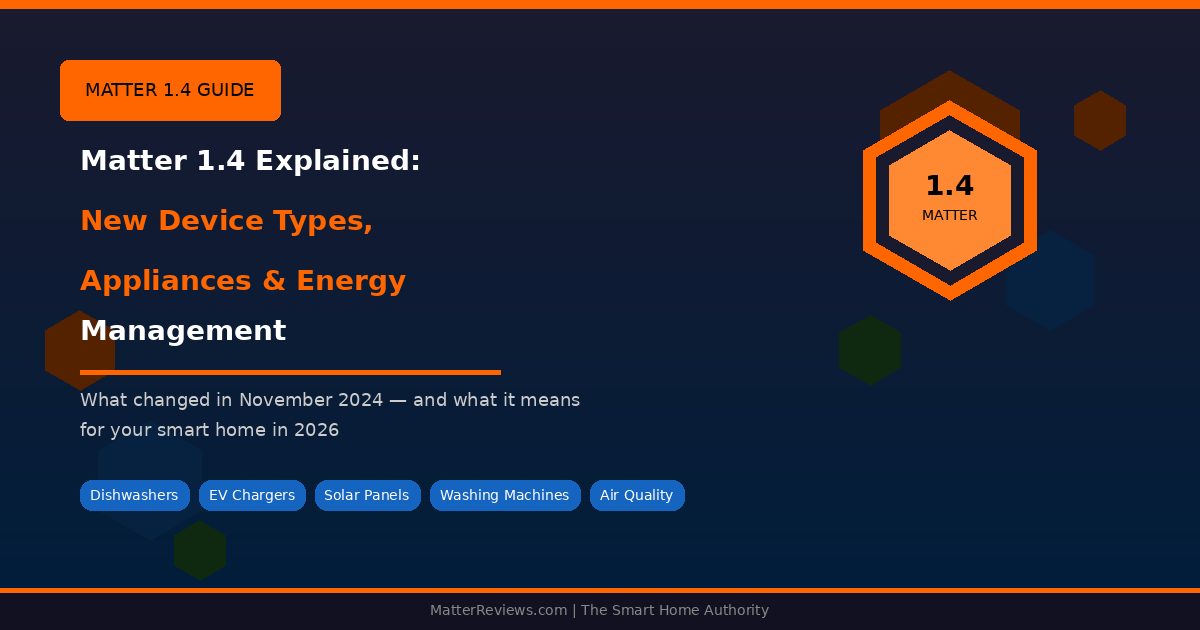
⚡ Quick Verdict: What Is Matter 1.4?
Released: November 5, 2024 by the Connectivity Standards Alliance (CSA).
Biggest change: Matter 1.4 expands smart home coverage to major home appliances — refrigerators, dishwashers, washing machines — plus full-home energy management including solar panels, EV chargers, heat pumps, and water heaters.
Also includes: Long Idle Time (LIT) for better battery life, Matter-certified routers (HRAP), enhanced multi-ecosystem support, and improved air quality sensors.
Bottom line: Matter 1.4 turns your smart home into a smart energy home. If you own appliances, solar panels, or an EV, this update matters — a lot.
When Matter 1.0 launched in late 2022, it promised something ambitious: a single, universal smart home standard that would end the era of fragmented, incompatible devices. It delivered on that promise for lights, locks, sensors, and plugs. But what about your refrigerator? Your dishwasher? Your EV charger sitting in the garage?
That’s exactly where Matter 1.4 comes in. Released on November 5, 2024, this update dramatically expands the range of devices that can speak the Matter language — and adds powerful new features that make your existing smart home devices smarter, longer-lasting, and more efficient.
In this guide, we break down everything that’s new in Matter 1.4 in plain English: which new devices are now supported, what new features matter for everyday users, and what it all means for your home in 2026.
💡 New to Matter? Check out our Complete Guide to the Matter Protocol and What Is Matter Smart Home in 2026? for the full picture before diving into the 1.4 specifics.
📋 Matter 1.4 at a Glance: What Changed?
Every new Matter version adds device types and features. Here’s how 1.4 compares to its predecessors:
| Version | Release Date | Key Additions |
|---|---|---|
| Matter 1.0 | Oct 2022 | Lights, switches, plugs, locks, thermostats, blinds, door sensors |
| Matter 1.1 | May 2023 | Bug fixes, improved reliability, enhanced commissioning |
| Matter 1.2 | Oct 2023 | Robot vacuums, refrigerators (initial), room air conditioners, smoke detectors, fans |
| Matter 1.3 | May 2024 | Energy reporting for appliances, microwaves, ovens, dishwashers (initial), EV chargers (basic) |
| ⭐ Matter 1.4 | Nov 2024 | Full appliance support, solar/battery/heat pumps, HRAP routers, LIT battery savings, enhanced multi-admin, air quality sensors |
Note: Matter 1.5 was announced in early 2025 and adds cameras and additional video device types — see our Aqara G350 review for the first Matter 1.5 camera.
🏠 New Device Types in Matter 1.4
The most visible change in Matter 1.4 is the dramatic expansion of supported device types. Here’s a category-by-category breakdown:
🍽️ Major Home Appliances
Matter 1.4 brings full support for large kitchen and laundry appliances — devices that were previously isolated islands in your smart home:
- Refrigerators — Monitor temperature zones, get door-open alerts, track energy usage
- Dishwashers — Start, pause, monitor cycles; schedule runs during off-peak electricity hours
- Washing Machines — Remote start/stop, cycle notifications, energy monitoring
The practical implications are significant. Imagine setting your dishwasher to run automatically when your home solar panels are producing surplus energy, or getting a push notification on your Apple Home or Google Home app the moment your laundry cycle finishes — all without needing a proprietary app from the appliance manufacturer.
🌟 Our Top Picks: Matter-Ready Appliance Brands to Watch
- Samsung — SmartThings ecosystem, deep Matter 1.4 integration roadmap
- LG — ThinQ platform aligning with Matter 1.4 for washers/dryers
- Bosch/Siemens — Home Connect platform confirmed for Matter certification
- Whirlpool — Early adopter of Matter appliance certification program
⚡ Energy Management Devices
This is arguably the most transformative addition in Matter 1.4. The spec now fully supports a Home Energy Management System (HEMS) — a coordinated network of energy-producing, storing, and consuming devices:
- Solar Panels — Real-time power production monitoring, integration with home automation
- Home Batteries — Charge/discharge control, reserve capacity settings, grid interaction
- Heat Pumps — Scheduling based on electricity rates, integration with thermostats
- Water Heaters — Off-peak scheduling, temperature control, energy tracking
- EV Chargers (EVSE) — Schedule charging for cheapest rates, set charge level limits, integrate with solar surplus
🌬️ Air Quality & Environmental Sensors
Matter 1.4 adds native support for a comprehensive range of environmental monitoring devices:
- Air Quality Monitors — Overall air quality index (AQI), PM2.5, PM10 particulates
- Carbon Monoxide (CO) Detectors — Life-safety integration with smart home automations
- Carbon Dioxide (CO₂) Monitors — Indoor air quality tracking, HVAC integration
- Ammonia Detectors — Industrial and agricultural use cases
- Radon Detectors — Long-term health monitoring with alerts
- Enhanced Leak & Freeze Sensors — More granular water and temperature detection
For existing Matter sensor users, check out our guide to the Best Matter Smart Sensors in 2026 — many of the top picks already support these enhanced sensing capabilities.
🔌 In-Wall Load Control Devices
Matter 1.4 introduces two brand-new device types that solve a long-standing gap for in-wall installations:
- Mounted On/Off Load Control — Controls non-smart wired devices (fans, heaters, appliances) from a wall switch
- Mounted Dimmable Load Control — Dimmer functionality for non-smart dimmable loads like halogen or LED lighting
Previously, these types of switches were awkwardly classified as “light” devices, which limited how they appeared in smart home apps and what automations were available. With dedicated device types, your fan switch finally shows up as a fan — not a light bulb.
🔋 Long Idle Time (LIT): A Game-Changer for Battery Life
Battery-powered smart home devices face a constant trade-off: stay connected and responsive, or save power. Matter 1.4 introduces Long Idle Time (LIT) — a protocol that lets Intermittently Connected Devices (ICDs) sleep for much longer periods between check-ins.
What this means in practice:
- Door/window sensors that currently last 1–2 years on a CR2032 battery could potentially last 3–4 years
- Motion sensors, buttons, and remotes spend less time transmitting and more time sleeping
- Network traffic is reduced — less congestion on your Wi-Fi or Thread mesh network
LIT works alongside the new Check-In Protocol, which ensures that even deeply sleeping devices can still receive important messages when they wake up. It’s the best of both worlds: long sleep cycles without missing critical commands.
📊 Technical Note: LIT devices can idle for intervals measured in hours rather than seconds, compared to the Short Idle Time (SIT) mode used by Matter 1.0–1.3 devices. The Check-In Protocol (CIP) guarantees reliable communication during these extended sleep cycles.
🌐 Home Routers & Access Points (HRAP): Infrastructure Gets Smart
One of the more technical — but highly practical — additions in Matter 1.4 is the introduction of Matter-certifiable Home Routers and Access Points (HRAP).
An HRAP-certified device combines two critical roles in one box:
- Wi-Fi Access Point — Standard home wireless networking
- Thread Border Router — Connects Thread mesh devices to your IP network
Before HRAP, most homes needed separate Thread Border Routers (typically built into smart home hubs like Apple HomePod Mini, Google Nest Hub, or Amazon Echo). HRAP lets your regular home router handle this role, simplifying setup and reducing the number of devices needed.
HRAP devices also maintain a secure directory of Thread network credentials, making it dramatically easier to add new Thread devices. Instead of each device needing to discover a Thread network separately, the HRAP handles credential sharing automatically.
🔗 Enhanced Multi-Admin: One Device, Every Ecosystem
Matter’s original multi-admin feature allowed devices to work with multiple smart home ecosystems simultaneously. Matter 1.4 makes this process significantly smoother.
The old way: Adding a device to a second ecosystem (say, adding an Apple HomeKit device to Google Home as well) required going through a full setup process again — scanning QR codes, re-pairing, and manually managing fabric credentials.
The Matter 1.4 way: Enhanced Multi-Admin allows existing and new devices to connect to additional ecosystems automatically, requiring only a single user consent prompt. You confirm once, and the device handles the rest behind the scenes.
This is a significant quality-of-life improvement for users who mix Apple Home, Google Home, Amazon Alexa, and Samsung SmartThings in the same household — which, in 2026, is increasingly common.
📡 Quieter Reporting: Less Network Noise
A quieter home network is a faster, more reliable one. Matter 1.4 introduces Quieter Reporting — a feature that reduces unnecessary network traffic from smart home devices.
Before Quieter Reporting, many Matter devices would broadcast attribute updates on a fixed schedule — even when nothing had changed. A temperature sensor might report “72°F” every 30 seconds whether the temperature moved or not.
With Quieter Reporting, devices intelligently suppress redundant updates for predictable, slowly-changing attributes. The result:
- Less congestion on Wi-Fi and Thread networks
- Improved battery life for reporting devices
- Faster response times for genuinely important events
- Better performance in large smart homes with 50+ devices
🔄 Is Matter 1.4 Backward Compatible?
Yes — completely. Matter is designed from the ground up to be backward compatible across all versions. Your existing Matter 1.0, 1.1, 1.2, and 1.3 devices will continue to work exactly as before after Matter 1.4 is adopted by your smart home platform.
Here’s what backward compatibility means in practice:
- ✅ Old devices still work — Your Matter 1.0 smart lock won’t stop working when your hub updates to 1.4
- ✅ New devices work with old hubs — A Matter 1.4-certified dishwasher will still connect to an Apple HomePod Mini running Matter 1.2 firmware (with 1.4 features not available)
- ✅ No mandatory upgrades — Matter 1.4 is an expansion, not a replacement
- ⚠️ New features require updated controllers — To take advantage of LIT battery savings or HRAP features, your smart home hub must support Matter 1.4
❓ Frequently Asked Questions
Does Matter 1.4 support robot vacuums?
Robot vacuums were actually added in Matter 1.2 (October 2023), not 1.4. If you’re looking for a Matter-compatible robot vacuum, check for the Matter 1.2+ certification mark. Matter 1.4 focuses more on appliances, energy management, and infrastructure improvements.
When will my smart home hub support Matter 1.4?
Matter 1.4 was released in November 2024, and major platforms rolled out support through 2025. As of 2026, Apple Home, Google Home, Amazon Alexa, and Samsung SmartThings all support Matter 1.4 through firmware updates to their respective hubs and apps. Check your hub manufacturer’s firmware release notes to confirm your specific device is updated.
Do I need to buy new devices to benefit from Matter 1.4?
For most new features, yes — you’ll need new Matter 1.4-certified devices. However, some improvements (like Enhanced Multi-Admin and platform-side Quieter Reporting) may benefit existing devices after a hub firmware update, depending on the manufacturer’s implementation.
What’s the difference between Matter 1.4 and Matter 1.5?
Matter 1.4 (November 2024) focused on appliances, energy management, and infrastructure. Matter 1.5 (announced 2025) adds support for security cameras and video streaming devices — which is why the Aqara Camera Hub G350 is the world’s first Matter v1.5 certified camera.
Are Matter 1.4 appliances available to buy now?
Yes — in 2026, several appliance manufacturers have begun shipping Matter 1.4-certified products. Samsung, LG, and Bosch have all announced or shipped Matter-compatible appliances. Availability varies by region and product category; check for the Matter certification badge when shopping.
🏆 What Matter 1.4 Means for Your Home in 2026
Matter started as a standard for light bulbs and door sensors. With Matter 1.4, it has become the foundation for a genuinely integrated smart home — one where your appliances, energy systems, sensors, and security devices all speak the same language.
Here’s the practical impact by household type:
| If You Have… | Matter 1.4 Benefit |
|---|---|
| Solar panels + home battery | Full Matter integration for energy monitoring and autonomous home energy management |
| An EV and home charger | Schedule charging based on electricity rates or solar production |
| New appliances (washer, dishwasher) | Remote control and smart scheduling from any Matter controller app |
| Many battery-powered sensors | LIT protocol extends battery life significantly |
| Multi-ecosystem home (Apple + Google + Alexa) | Enhanced Multi-Admin simplifies connecting devices across all your platforms |
| Thread mesh network (10+ devices) | HRAP routers simplify network management and Thread credential sharing |
The trajectory is clear: Matter is no longer just for security and lighting. It’s becoming the operating system for the entire connected home. Appliances that have sat outside the smart home ecosystem for decades are finally being brought into the fold — and the energy management capabilities arriving with 1.4 could meaningfully impact household electricity bills.
If you’re building or expanding a Matter smart home in 2026, understanding what’s in 1.4 is essential for making the right device choices today.
📚 Related Articles You'll Love
- 🔒 Best Matter Smart Locks 2026 — Top picks for every budget and ecosystem
- 📡 Best Matter Smart Sensors 2026 — Door, motion, and environmental sensors reviewed
- 📷 Aqara Camera Hub G350 Review — The world's first Matter 1.5 security camera
- 🏠 What Is Matter Smart Home in 2026? — The complete beginner's guide
- 🔑 What Is Matter Protocol? — Deep dive into how it all works
Last updated: April 2026 | Information sourced from CSA-IOT.org, Silicon Labs, and manufacturer announcements
Thanks for the information!